Independent and unofficial. The Test Fixture is not affiliated with, endorsed by, or operated by any model developer or platform mentioned here. LTX-2.3 and related marks belong to their respective owners.
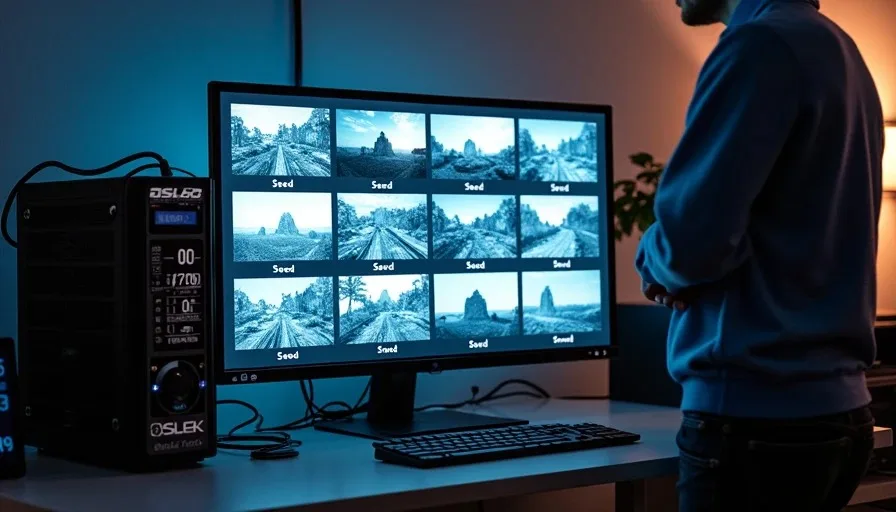
A fixed seed is often treated as a reproducibility switch. Set it, and the same prompt should give you the same video. That is true at the file level, and it is not the same thing as stability at the output level.
This test asks a narrower question: with one prompt held constant, how much does the output actually move across ten seeds? Not “is the model deterministic.” That question has a technical answer, and it is partly yes. The useful question is whether a seed change produces a different but equivalent result, or a different class of result.
Test question
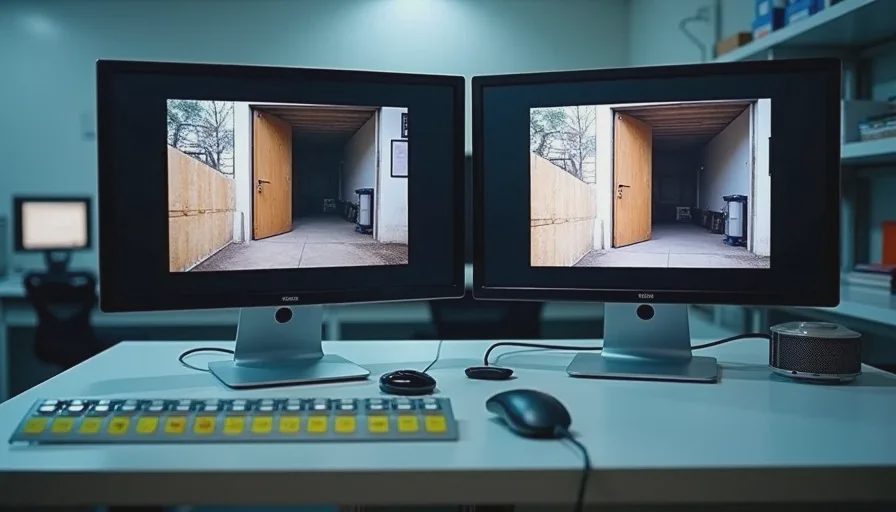
Holding prompt, resolution, duration, sampler, steps, CFG, and runtime constant, how much does a single LTX-2.3 text-to-video output vary across ten fixed seeds, measured by subject position, composition, motion behavior, and failure category?
This is not a benchmark. Ten seeds on one prompt is a variance probe. It tells you whether this prompt is seed-sensitive and where the sensitivity shows up. It does not tell you how the model behaves across prompts.
Configuration
Hardware
GPU: single consumer GPU, 24 GB VRAM.
CPU: current desktop-class processor.
System RAM: 64 GB.
Storage: NVMe for runtime and model files; separate drive for outputs.
Software
OS: current Linux desktop distribution. [Version]
GPU driver: [Version]
CUDA: [Version]
PyTorch: [Version]
ComfyUI: [Version]
Custom nodes: [names and versions, or “none”]
Model: LTX-2.3, [exact identifier / commit / quantization]. Checksum: [if available].
Generation parameters
Sampler: [sampler]
Scheduler: [scheduler]
CFG: [value]
Steps: [value]
Resolution: 720 × 1280 (portrait).
Frames: [value]. FPS: [value]. Duration: [value].
Motion / denoise settings: [values]
Seed policy: fixed seeds 0–9. No seeds selected after reviewing outputs.
Test set ID:
variance-001.
Prompt
A middle-aged man in a brown work jacket walks slowly across a gravel yard toward a corrugated metal shed. Overcast light. Fixed camera, eye level. His hands stay visible. The shed door is closed. No cuts.
The prompt is intentionally specific about subject, action, camera, and one constraint (closed door). It is not a beauty prompt. It is a test prompt.
Runs
Conditions: 1 prompt × 10 seeds.
Runs per condition: 1 per seed.
Warm-up: one warm-up run discarded before seed 0.
Discarded runs: none after warm-up. If a run had been discarded, it would be listed here with the reason.
Observation
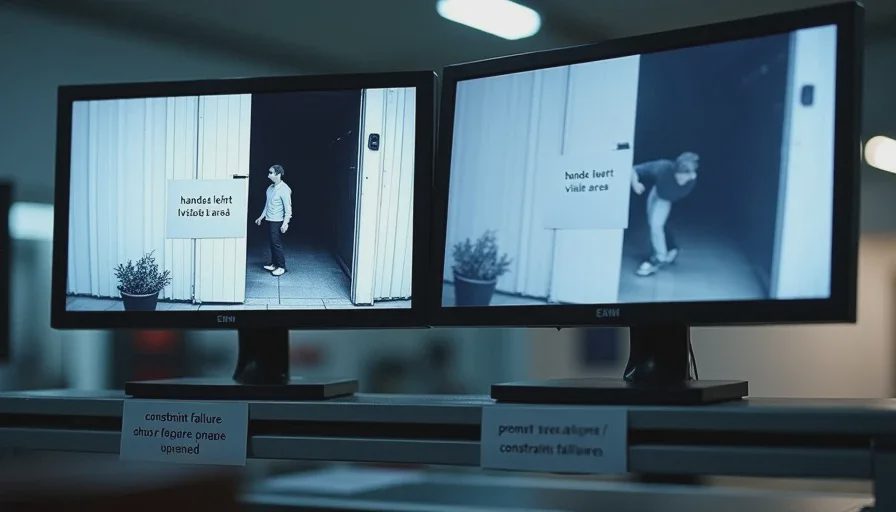
Across ten seeds, the outputs split into three groups.
Group A: equivalent outputs (5 of 10 seeds). The subject walked across the yard, the camera held, and the shed door stayed closed. Subject position at mid-clip varied by less than half a body width. These runs are not identical files, but they answer the test question the same way. They are a different draw from the same distribution.
Group B: composition drift (3 of 10 seeds). The subject started at a different distance from the camera, which changed the apparent walking speed and the frame at which he reached the shed. In two of these, the subject drifted toward the frame edge and was partly out of frame by the final second. The camera did not move; the staging did.
Group C: constraint failure (2 of 10 seeds). In one run, the shed door opened mid-clip. In another, the subject’s hands left the visible area for more than a second. These are not composition differences. They are failures of a stated constraint.
No temporal flicker was obvious in the Group A runs at normal review speed. In Group C, the door-opening run showed a brief luminance shift around the door frame, but I did not isolate whether that was the model or the review pipeline. That is logged as an unconfirmed observation, not a finding.
Interpretation
Confidence: moderate.
The useful observation is not “the model is unstable.” It is that seed sensitivity concentrated in staging and constraint adherence, not in gross motion failure. The subject walked in every run. The camera held in every run. What moved was where the subject started, how much frame he occupied, and whether the door constraint held.
That distinction matters for workflow design. If the failure mode were “the model cannot walk a subject across a frame,” no seed would fix it. If the failure mode is “the model sometimes stages the subject differently or drops a constraint,” then seed selection and constraint reinforcement become practical levers, and the test question changes from “does it work” to “how many seeds does it take to get a usable run, and can I tell before watching the whole clip.”
The file-level reproducibility result is consistent with published LTX-2.3 rerun behavior: a rerun with the same seed reproduces decoded frames exactly in the reported setup, while LTX-2.3 shows a small nonzero sampler floor in some conditions. File-level determinism and output-level stability are different properties. This test is about the second one.
Failure cases
Failure category: prompt contradiction / constraint failure. Two of ten runs violated the “shed door is closed” constraint. Sample count: 2. Reproducible: not yet checked across repeated runs of the same failing seeds. Attribution: undetermined. It could be the model, the prompt wording, or the specific seed. A follow-up will rerun the two failing seeds three times each to separate seed-specific failure from stochastic constraint drift.
Failure category: composition drift. Three of ten runs placed the subject differently at the start, and two of those let the subject drift partly out of frame. Sample count: 3. Reproducible: partial; the initial staging difference was visible in all three, but the out-of-frame drift occurred in two. Attribution: likely model staging variance under a fixed camera instruction, not a workflow error.
Unconfirmed observation: luminance shift. One run showed a brief shift around the door frame. Not categorized as temporal flicker until it is isolated from the review pipeline.
Reproduction notes
Prompt text is included above with a stable test set ID. Seed list is 0–9. The configuration manifest for this test will be published as variance-001.json with the fields listed in the configuration block. Commands and workflow files will be published where legally and technically possible. Model files and installers are not distributed.
If you rerun this and get a different split, the useful information is not just the count. It is which category changed. A rerun that produces more Group A runs under the same configuration is a different result from a rerun that produces the same Group C failures. Both are informative.
What this test does not show
It does not show that ten seeds is enough. It does not show that this prompt is representative of LTX-2.3’s behavior. It does not show that a different resolution, duration, or motion setting would produce the same split. It does not show that the failing seeds fail for the same reason. And it does not show that a passing seed will keep passing after a runtime update. That is why the correction log exists.
The configuration is part of the result. A successful sample is evidence. It is not a warranty.
If it can’t be reproduced, it’s a story—not a result.