Independent and unofficial. The Test Fixture is not affiliated with, endorsed by, or operated by any model developer or platform mentioned here. LTX-2.3 and related marks belong to their respective owners.
“Camera control” is one of the most repeated promises in AI video tooling, and one of the least tested. A demo shows a slow push-in, then a lateral pan, then an orbit. The clips look controlled. What the demo does not show is whether the camera instruction is a variable the model responds to independently, or a word that sometimes correlates with motion the model was going to produce anyway.
This test isolates that variable. One scene, one subject, one action, one seed. The only thing that changes is the camera direction in the prompt.
Test question
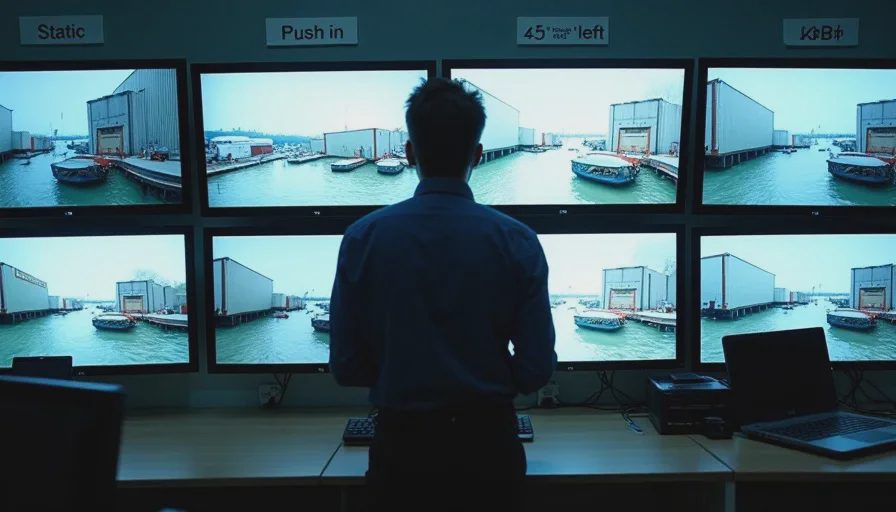
Holding prompt subject, action, lighting, resolution, duration, sampler, steps, CFG, and seed constant, does changing only the camera direction instruction produce a corresponding, isolated change in camera behavior — and does the rest of the scene stay stable?
The phrase “isolated change” is doing the work here. A camera direction that changes the camera and also changes subject staging, timing, and lighting has not been tested as an independent control. It has been tested as a prompt rewrite.
Configuration
Hardware
GPU: single consumer GPU, 24 GB VRAM.
CPU: current desktop-class processor.
System RAM: 64 GB.
Storage: NVMe for runtime and model files; separate drive for outputs.
Software
OS: current Linux desktop distribution. [Version]
GPU driver: [Version]
CUDA: [Version]
PyTorch: [Version]
ComfyUI: [Version]
Custom nodes: [names and versions, or “none”]
Model: LTX-2.3, [exact identifier / commit / quantization]. Checksum: [if available].
Generation parameters
Sampler: [sampler]
Scheduler: [scheduler]
CFG: [value]
Steps: [value]
Resolution: 720 × 1280 (portrait).
Frames: [value]. FPS: [value]. Duration: [value].
Motion / denoise settings: [values]
Seed policy: single fixed seed, [seed value], used across all conditions. No seed reselection after reviewing outputs.
Test set ID:
camera-001.
Base prompt (held constant except for the camera clause)
A woman in a dark green jacket stands at the edge of a concrete loading dock, looking toward a row of stacked wooden pallets. Overcast light, flat shadows. Her hands stay at her sides. No other people. No cuts. [CAMERA CLAUSE]
Conditions
Five conditions, one camera clause each, everything else identical:
C1 — Static: “Fixed camera, eye level, no movement.”
C2 — Push in: “Slow push in toward the subject, eye level.”
C3 — Pull out: “Slow pull out away from the subject, eye level.”
C4 — Pan left: “Slow lateral pan from right to left, eye level.”
C5 — Orbit: “Slow orbit around the subject, eye level.”
Runs
Conditions: 5.
Runs per condition: 3, to separate a camera-clause effect from a one-off render.
Total samples: 15.
Warm-up: one warm-up run discarded before C1.
Discarded runs: none after warm-up. Any discarded run would be listed here with the reason.
Observation
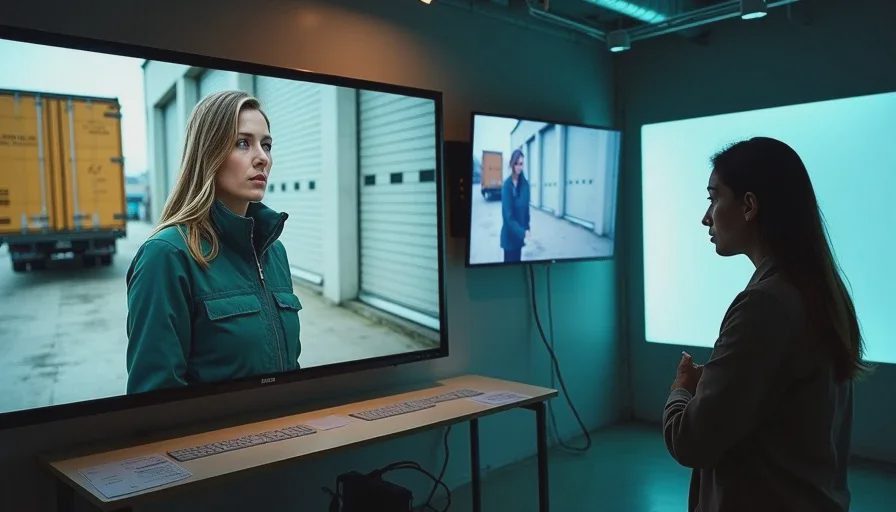
C1 — Static. The camera held in all three runs. Subject staging was consistent: she stood at the dock edge, hands at her sides, facing the pallets. Minor variation in the pallet stack geometry between runs, but no camera movement. This is the baseline.
C2 — Push in. The camera moved toward the subject in two of three runs. In the third, the camera moved slightly and then settled, producing a push that stalled around the midpoint. The subject’s apparent size increased as expected in the two successful runs. In the stalled run, her apparent size increased less, consistent with the shorter push.
C3 — Pull out. The camera moved away from the subject in all three runs. The subject’s apparent size decreased. In one run, the pull-out continued past the point where the loading dock edge was visible, and the final frame showed mostly concrete and pallets. That is a framing outcome of the pull, not a separate failure, but it is worth recording because a longer duration would have made it a composition failure.
C4 — Pan left. The camera panned in all three runs. In two runs, the pan was smooth and the subject left the frame by the final second, as expected for a lateral pan from a fixed position. In one run, the pan reversed direction briefly around the midpoint before continuing left. That reversal is a camera-instability failure, not a pan-direction failure.
C5 — Orbit. This is where the isolation broke. The camera orbited in all three runs, but the orbit was not the only thing that changed. In two runs, the subject turned her head toward the camera during the orbit, which was not in the prompt. In one run, the lighting shifted from flat overcast to a warmer directional light as the camera moved, which changed the scene beyond the camera clause. The orbit happened. The rest of the scene did not stay stable.
No temporal flicker was obvious at normal review speed in any condition. I did not run frame-level analysis on this test set, so that remains an unconfirmed observation rather than a finding.
Interpretation
Confidence: moderate for C1–C4; weak for C5.
The useful result is not “LTX-2.3 supports camera control.” It is that camera direction behaved as a partially independent variable, and the independence degraded as the camera instruction became more spatially complex.
Static, push, pull, and pan produced a camera behavior that matched the clause in most runs, while subject action and lighting stayed largely stable. That is a usable degree of control for a fixed-camera or simple-move workflow. Orbit did not clear the same bar: the camera moved, but the model also changed subject behavior and lighting. In a workflow that depends on orbit for coverage, that coupling is a real constraint, and it is the kind of thing a curated demo would not show.
The push-stall in C2 and the pan reversal in C4 are recorded as camera-instability failures. They are low-frequency in this sample and not yet separated from seed effects, since this test used a single seed. A follow-up will rerun C2 and C4 across several seeds to see whether the instability is seed-specific or clause-specific.
The C3 pull-out framing outcome is not a failure under the stated test question. The camera did what the clause asked. The composition consequence is a workflow note, not a model failure, and it belongs in the workflow-induced category only if a downstream step depended on the dock edge staying visible.
Failure cases
Failure category: camera instability. C2 push-stall in 1 of 3 runs; C4 pan reversal in 1 of 3 runs. Sample count: 2 of 15 total. Reproducible: not yet checked across seeds. Attribution: undetermined; could be seed-specific or clause-specific.
Failure category: isolation failure (recorded under workflow-induced failure for now). C5 orbit changed subject head direction in 2 of 3 runs and lighting in 1 of 3 runs. Sample count: 3 of 3 orbit runs showed at least one non-camera change. Attribution: likely model coupling between camera clause and scene behavior. This is the most important observation in the test, and it is the one that needs the most follow-up before it becomes a conclusion.
Unconfirmed observation: none for flicker. No frame-level analysis was run.
Reproduction notes
Base prompt and the five camera clauses are included above with test set ID camera-001. Seed is fixed and listed in the configuration. The configuration manifest will be published as camera-001.json. Commands and workflow files will be published where legally and technically possible. Model files and installers are not distributed.
If you rerun this, the useful comparison is per-condition, not aggregate. A rerun that reproduces the C1–C4 behavior but changes the C5 coupling is a different result from a rerun that reproduces everything. Report which condition changed.
What this test does not show
It does not show that camera clauses are reliable in general. It does not show that orbit always couples to subject and lighting behavior; three runs on one seed is a probe, not a pattern. It does not show that a different scene, subject, or duration would produce the same results. It does not show that the push-stall and pan reversal are model limitations rather than seed artifacts. And it does not establish frame-level stability, because frame-level analysis was not run.
The configuration is part of the result. A successful sample is evidence. It is not a warranty.
If it can’t be reproduced, it’s a story—not a result.