Independent and unofficial. The Test Fixture is not affiliated with, endorsed by, or operated by any model developer or platform mentioned here. LTX-2.3 and related marks belong to their respective owners.
A good demo is designed to be watched. A test report is designed to be checked. These are different goals, and confusing them is the most common mistake readers make with AI video.
This is not an argument against demos. A demo is useful. It can show what a model is capable of under some conditions, and it can give you a feel for output style faster than any table of numbers. The problem is not the demo. The problem is treating the demo as if it were a result.
This post is a reading guide. It is not a test report. It is how I watch a demo before I decide whether to trust it, cite it, or ignore it.
The question to ask first
Before watching, ask one question: what is this clip trying to prove?
There are at least four different things a clip can be, and they are not interchangeable:
A capability showcase. “Look what the model can do.” Usually curated, often impressive, not a claim about frequency or reliability.
A workflow demonstration. “Here is how to use it.” Shows the process, not the output distribution.
A comparison. “This model beats that model.” Requires controls that demos usually do not have.
A product page. “Buy this.” The clip is marketing, which is allowed, but should be labeled as such.
A clip that does not say what it is trying to prove is not hiding anything by default. It is just being watched as the wrong kind of evidence.
The ten-second check
Before I watch a demo, I scan for the things that would let me use it as evidence. Most demos fail this check in the first ten seconds.
Is there a version number? “Latest” is not a version. “LTX-2.3” without a commit or build is a family name, not a test condition.
Is there a configuration? Resolution, duration, frame count, sampler, steps, CFG, seed. If the clip is 30 seconds and the description is “made with LTX-2.3,” the configuration is missing.
Is the clip edited? Cuts, speed changes, crossfades, and music cues are not deceptions, but they are also not evidence of continuity. A one-take clip and a montage are different kinds of claims.
Is there a failure sample? A demo with no failures is a selection, not a sample. That is fine for a showcase and not fine for a capability claim.
Is there a disclosure? Sponsorship, free credits, affiliate links, or a direct relationship with the model developer. Not a red flag by itself. A missing disclosure is.
None of these are moral judgments. They are filters that decide what the clip can and cannot support.
What demos are good for
Demos are genuinely good at three things:
Style and aesthetic range. A demo is the fastest way to see whether the output looks like what you want. That is a real, useful judgment, and it does not need a configuration block.
Feasibility signals. If a demo shows a 20-second clip with consistent subject identity, that is a signal that the workflow exists in some form. It is not proof that you will get it, but it is evidence that the target is not imaginary.
Workflow ideas. A demo that shows the pipeline — nodes, prompts, parameters — is more useful than one that shows only the output, even if the output is less polished.
That is a short list. It is honest about what a demo can do.
What demos cannot do
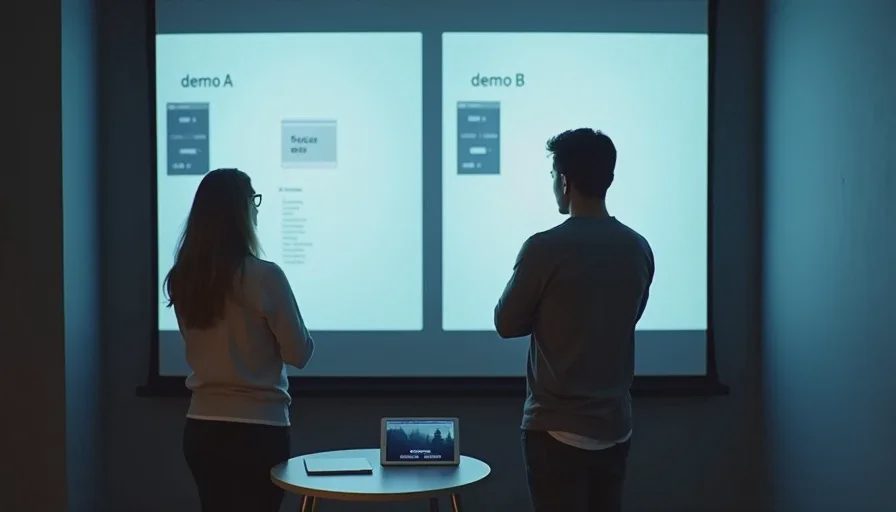
A demo cannot tell you:
How often the result happens. One clip is one sample. It may be the best of fifty.
Whether it reproduces. Without a seed and configuration, a clip is a story with a timestamp.
Whether it generalizes. A demo is often a curated prompt on a favorable scene. That is not the same as a capability.
Whether the workflow is stable. A clip that works today may not work after a runtime update, and the demo will not tell you because it was recorded before the update.
Whether a constraint held. “The hands stayed visible” in a clip is an observation, not a guarantee. It may be luck.
These are not reasons to distrust demos. They are reasons to file them under the right category.
The distraction problem
The most common failure mode is not deception. It is attention.
A polished clip with music and a dramatic camera move is engineered to make you feel that the capability is solved. That feeling is real and it is not evidence. When I watch a demo, I try to separate three reactions:
The aesthetic reaction. “That looks good.” Useful, but not a test result.
The capability reaction. “That did a thing I did not expect.” Worth investigating, not yet a conclusion.
The evidence reaction. “That did a thing, under these conditions, and here is what would falsify it.” This is the one that belongs in a test report.
Most demo-watching stops at reaction one. Most productive demo-watching goes to reaction two and then asks what it would take to reach reaction three.
A practical reading checklist
When I watch a demo I intend to cite or compare, I run this checklist. It is short on purpose.
What kind of clip is this? Showcase, workflow, comparison, or marketing.
What conditions are stated? Version, configuration, seed, hardware.
What is edited? Cuts, speed, music, transitions.
What is missing? Failure samples, sample counts, disclosure.
What claim is being made? Capability, reliability, comparison, or product.
What would change my mind? The condition that, if different, would make the clip unimpressive.
If a demo cannot answer the last question, I do not cite it as evidence. I may still enjoy it. I just will not treat it as a result.
A note on links and downloads
Demos are also a common path to unofficial downloads, “mirror” pages, and account prompts. This site does not distribute model files or installers, does not run a download portal, and does not ask readers for passwords, API keys, verification codes, wallet details, recovery codes, or remote access. When a video description points to an unfamiliar download page, the safe move is to go to the model developer’s official documentation through a source you already trust, not through a link in a video description.
That is not a comment on any specific demo. It is a general rule, and it is the reason this site links to official documentation with descriptive labels rather than button-style calls to action.
What this post is not
It is not a ranking of demos or a criticism of any specific creator. It is not a claim that every demo is misleading. It is not a substitute for the Reproducibility Protocol; it is a reading guide that sits in front of it.
That is an observation, not yet a conclusion. A demo is a claim. A test report is a claim with conditions. The gap between them is where most AI video arguments happen, and it is the gap this post is about.
A successful sample is evidence. It is not a warranty.
If it can’t be reproduced, it’s a story—not a result.