Independent and unofficial. The Test Fixture is not affiliated with, endorsed by, or operated by any model developer or platform mentioned here. LTX-2.3 and related marks belong to their respective owners.
A thumbnail is not a test result.
This sounds obvious until you watch how AI video clips are evaluated. The first frame is often the most polished frame in the clip, because it is the frame the model and the viewer both treat as the establishing shot. When the first frame is sharp, well-composed, and on-prompt, it creates a strong impression that the rest of the clip will hold. Often it does. Sometimes it does not, and the gap between “frame one looks right” and “the clip is temporally consistent” is where a lot of wasted production time lives.
This post is a failure-analysis breakdown, not a model verdict. The question is narrow: what can a successful first frame actually prove, and what does it systematically fail to prove?
Test question
Given an output whose first frame satisfies the prompt, what failure modes can still appear later in the clip, and what frame-level evidence distinguishes a first-frame success from a temporally consistent result?
This is a methods post. The examples are drawn from my test bench logs and from failure patterns reported in public LTX-2.3 discussions. The attribution rule applies to any video model.
What a good first frame actually proves

A successful first frame proves a real thing, and it is worth stating precisely so the rest of the post is not read as dismissing it.
It proves that, at frame one, the model resolved the prompt into a plausible composition: subject, framing, lighting, and style were consistent with the instruction. That is not trivial. A model that cannot produce a good opening frame has a prompt-following problem, and that is a legitimate finding.
What it does not prove is that the resolution persists. Composition at frame one is a snapshot of a single decode step. Temporal consistency is a property of the relationship between frames over time. These are different measurements, and one does not imply the other.
The failure modes that hide behind a good first frame
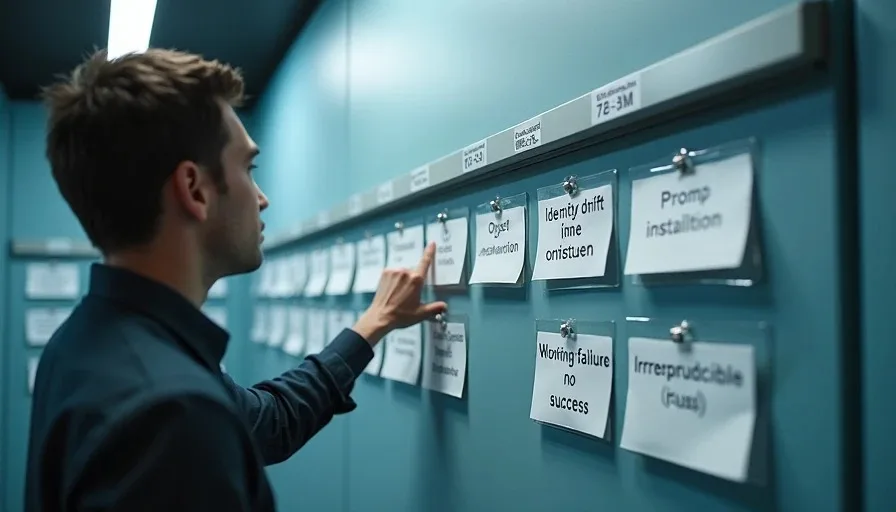
In my logs, the failures that follow a strong opening frame cluster into five categories. None of them are visible if you only review the first frame or a thumbnail.
1. Identity drift. The subject’s face, clothing, proportions, or object identity changes across frames or shots. The opening frame sets the expectation; the drift breaks it. This is the most common failure to survive a thumbnail review, because the first frame is exactly where identity is strongest.
2. Temporal flicker. Luminance, texture, or detail instability appears after the opening frames, often in high-motion or high-texture regions. A still first frame cannot show flicker by definition; it is a single frame.
3. Object deformation. Geometry or structure degrades: limbs bend incorrectly, objects merge, architecture warps. The opening frame often shows the object intact, and the deformation appears once the object moves or the camera changes.
4. Camera instability. Motion that should be smooth jitters, reverses, or breaks continuity. The first frame is a camera position, not a camera path.
5. Constraint violation after the opening. The prompt’s constraints hold at frame one and fail later: a closed door opens, hands leave the visible area, a background element appears. In the seed-variance test I published earlier, two of ten runs violated the “shed door is closed” constraint; in at least one, the violation appeared after the opening frame, not at it.
Each of these is a temporal failure. None of them can be ruled out by a good first frame.
Why the first frame gets over-weighted
Three reasons, and all three are about how clips are reviewed rather than what the model does.
The thumbnail is the review unit. In feeds, galleries, and model comparison pages, the first frame is often the only frame a reader sees before deciding to watch. The clip’s evaluation is partly decided by a single frame. That is a presentation effect, not a model property, but it shapes what gets shared and what gets cited.
The opening frame is where the prompt is most fully resolved. Early frames tend to be the most on-prompt, because the model has the most context available and the least accumulated drift. Reviewing early frames is reviewing the model at its most favorable moment.
Short review windows favor openings. A reviewer who watches three seconds of a thirty-second clip has seen the opening and inferred the rest. That inference is usually right and occasionally very wrong, and the wrong cases are the ones that cost production time.
How to check temporal consistency without a full analysis pipeline
The check does not require a frame-diff tool or a research setup. It requires reviewing the clip as a sequence rather than a poster.
Step 1 — Watch the full clip once without pausing. Note where your attention breaks. That break is a candidate failure, not yet a finding.
Step 2 — Extract frames at a fixed interval. Every N frames, or at scene boundaries if the clip has them. Review the frames as a sequence, not individually.
Step 3 — Compare first frame, midpoint, and final frame directly. Identity, composition, lighting, and constraints. If the first frame and the final frame disagree on something the prompt specified, that is a temporal failure candidate.
Step 4 — Check the frame range around each attention break. Review decoded frames losslessly, not the preview. The flicker diagnostic sequence from the earlier post applies here: rule out the review pipeline before attributing to the model.
Step 5 — Rerun the same seed. If the failure recurs at the same frame range, it is deterministic under these conditions. If it does not, the failure is stochastic and needs more runs before it becomes a pattern.
Step 6 — Record frame ranges and sample counts. “It drifts” is not a record. “Identity drift visible by frame 36 in 7 of 10 runs at 720p” is.
This is a minimum check. It is not a full temporal analysis, and it will miss subtle failures. It is enough to catch the failures that a first-frame review systematically hides.
A worked example from the bench
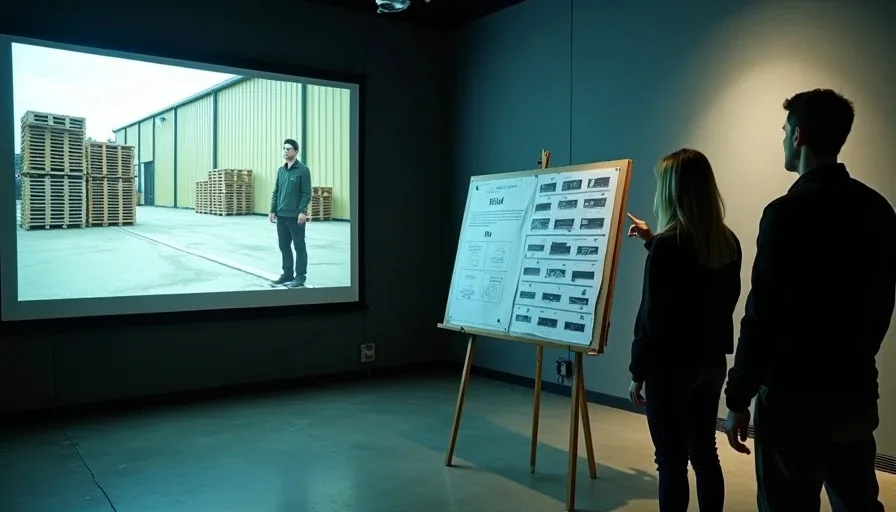
In the seed-variance test, the Group C run where the shed door opened is a clean example. The opening frame showed a closed door, as prompted. The door opened mid-clip. A thumbnail review would have passed the run. A frame-sequence review would have caught it, and did.
In the same test, the two runs where the subject drifted partly out of frame showed a different pattern: the opening frame was well-composed, and the drift accumulated over the clip. The first frame was not the failure; the first frame was the expectation that the later frames broke.
Both cases are recorded as prompt-contradiction or composition failures, with frame ranges where available. Neither is recorded as “the model cannot follow the prompt,” because a first-frame success plus a later failure is a conditional observation, not a universal conclusion.
Failure entry format
Every temporal-consistency report on this site will use the standard failure fields, with two additions specific to this failure mode:
Test question. What the run was supposed to show.
Conditions. Configuration reference, seed, run number, hardware and software versions.
First-frame status. Did the opening frame satisfy the prompt? Yes, no, or partial.
What failed. Category, frame range, description before interpretation, and whether the failure was visible in decoded frames or only in preview.
How often. Sample count and failure rate.
Reproducible? Yes, no, or partial, with the rerun described.
Attribution. Model, workflow, review pipeline, or undetermined.
What would change the conclusion. The condition that would move the failure to a different category.
The first-frame status field exists because “the first frame was fine” and “the clip was fine” are different claims, and a report that does not separate them is easy to misread.
What this post does not show
It does not establish that LTX-2.3 has a temporal-consistency problem. That would require a multi-seed, multi-condition test set with frame-level analysis, and this post is a diagnostic framework, not that test. It does not claim that all demos hide temporal failures; many clips are genuinely consistent, and the check above is how you tell. It does not rank failure modes by severity, because severity depends on the workflow, and a drift that ruins a character shot may be irrelevant to an abstract clip.
The configuration is part of the result. A successful sample is evidence. It is not a warranty.
If it can’t be reproduced, it’s a story—not a result.